
The following article was written by Trinity's David Leavell '28 and was featured in the Trinity ECHO. For more stories from the ECHO, visit trinityecho.com.
In high schools across America, institutions are often defined as the students and faculty who walk in their halls each year. In reality, schools are grounded in decades of history, traditions, culture, and a collective experience that quietly shape the school over time. At Trinity High School, our legacy is not left to memory alone. From former student awards to the hat of a former pope, Barbara Mullen, the school Archivist, carefully preserves Trinity’s unique history, stating, "Trinity High School Archives was started in 1983. For over 40 years, the Archives has served as a repository for the school's historical documents and artifacts.” Among these many artifacts, several stand out and paint a picture of Trinity’s past.
The Wall
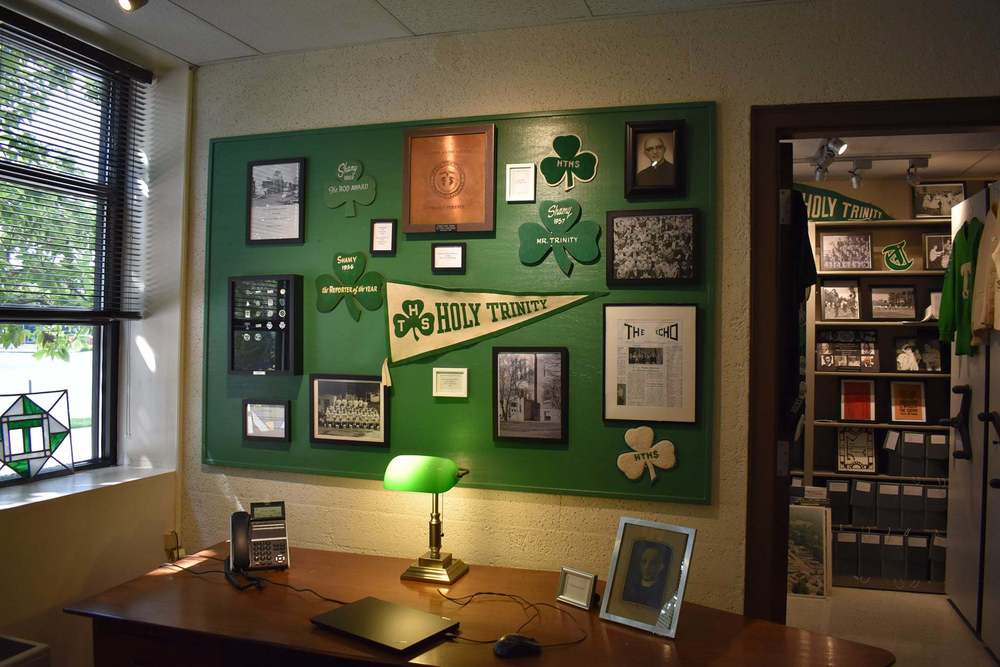
The first thing in sight when in the illustrious Archives room is a wall of Trinity memorabilia. Among many enigmatic artifacts, a few stand out. One of the oldest artifacts in the archives included a pennant reading “Holy Trinity.” When the school first opened in 1953, it was originally named “Holy Trinity High School.” However, because Holy Trinity School and parish moved to another place, it caused a LOT of confusion. As a result, in 1955, the school officially dropped the “Holy” and became Trinity High School, the school everyone knows and loves today.
Shammy Awards
Another standout among the many remarkable artifacts on the wall is the Shammy Awards, one of Trinity’s most celebrated traditions. The award dates back nearly 75 years, originally called a “Shamy”, before it changed to the Shammy award in the early 60’s. These awards recognize outstanding members of the senior class. The Senior Class votes on who receives an award, including titles such as Mr. Basketball, Mr. Football, and even Mr. Trinity. Out of 19,000 Trinity graduates, only about 1,000 have ever received one of these Shammys, making it an important tradition for the senior class.
Spirit Buttons
Other artifacts are more common, reflecting the everyday life of Trinity students from another time. Spirit buttons, sold in the school bookstore for about 25 cents in the 1960s and ‘70s, were an integral part of Trinity’s spirit wear. Students would collect these and wear them with pride, pinning several onto their shirts before games to show school spirit. Although small in stature, they represent the lasting school spirit passed down through generations of Shamrocks.
Cheer Team & Gym Bag
Some artifacts highlight Trinity’s lesser-known athletic history, in stark contrast to the tradition held today. A good example of this is a patch from a cheer megaphone sweater, representing a time when Trinity had its own male cheerleading team; they led chants, boosted spirit, and helped rally the crowd during school events. Nearby sits a school gym bag from the ‘70s, carried by Trinity students going to gym class.
Father Duerr & Father Steinhauser
The archives also preserve artifacts that reflect the personalities that shaped Trinity. Father Duerr, who spent many years serving the school and has a building named after him, was an avid sailor. In his free time, he would even compete, collecting an array of trophies now on display inside the Communication Arts building. Father Steinhauser, on the other hand, greatly enjoyed fishing, having a very broad collection of lures and equipment. Their hobbies serve as a reminder that the people who shaped Trinity’s history had lives and passions beyond the classroom.
Pope Pius XII hat
Perhaps the most unique artifact in the archives is a skull cap belonging to Pope Pius XII, the pope when Trinity was founded in 1952. The hat, otherwise known as a zucchetto, was donated by Stephanie Rickert, a close friend of Trinity. Rickert acquired the hat from the Vatican, bringing it all the way back to Louisville, KY, where it remains preserved as a part of Trinity’s archives.
A Legacy Preserved
Together, these artifacts serve as a snapshot of Trinity’s past. All well preserved within the archives, they ensure that Trinity does not forget the traditions, stories, and personalities that helped build the school.