Join us for “Rock Reflections,” a series celebrating Trinity alumni. From 48 states to countries worldwide, our graduates are making an impact, and we'll share their stories on Trinity's website and social media.
This week, we’re reflecting with Dr. John Kleber '59. What follows is John's biography and an interview.
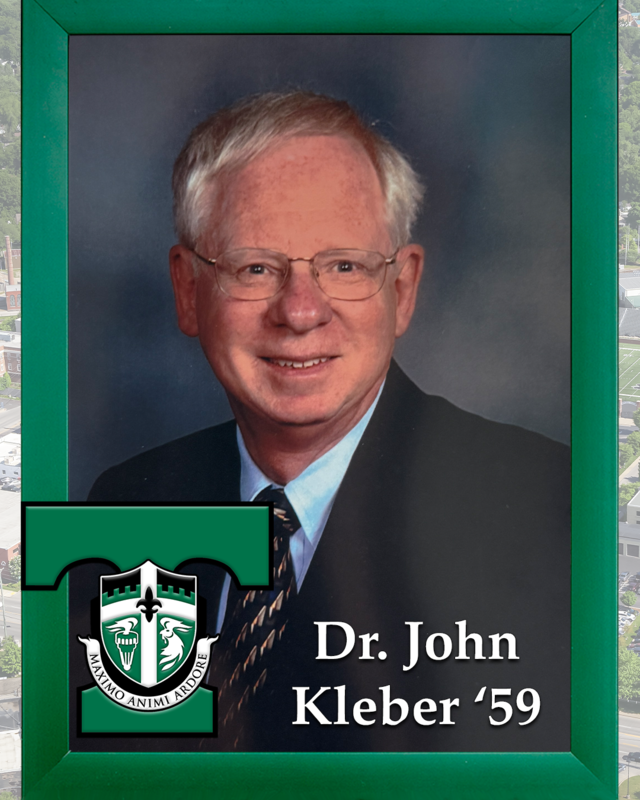
John Kleber ’59, Ph.D., is one of the most learned men to have graduated from Trinity. His curriculum vitae is lengthy and distinguished, but his ties to his hometown and state remained. Trinity’s founding principal, Monsignor Alfred Steinhauser, was instrumental in his life.
As a Trinity student, John was a four-time Shamrock Award recipient for his academic success. He went on to become one of Kentucky's most respected historians, researchers and teachers.
After graduating from Trinity, John earned a bachelor’s degree in history from Bellarmine University in 1963 (summa cum laude). His master’s degree (1965) and Ph.D. (1969) in history were earned from the University of Kentucky. Morehead State University was his home for many years, where he served as professor of history, director of the Academic Honors Program and dean of the Caudill College of Humanities.
John served on the United States Senate Commission on Art in 2007. He’s the editor of six books, including the popular “The Kentucky Encyclopedia” and “The Encyclopedia of Louisville.” One of his most recent books is the history of Shelby County, Kentucky. His works are important historical documents and will remain significant to Kentucky historians.
Some of John’s awards and memberships include Department of the Army Outstanding Civilian Service Medal, Governor’s Outstanding Kentuckian Award, and member of the Kentucky Historical Society.
Additionally, John’s papers, book reviews and articles have been published in more than 30 journals and presented at numerous conferences. In 1998, he addressed the Kentucky State Senate at its opening session.
John recently retired from the McConnell Center at UofL where he was a senior fellow for 20 years. John was honored at the Salute to Catholic School Alumni and inducted into the Trinity Hall of Fame in 2000. In 2001, Bellarmine University installed him in the Distinguished Gallery of Graduates.
Where did you attend grade school?
St. Aloysius Catholic School, which was in the Irish Hill neighborhood on Payne Street. It was a neighborhood of shotgun houses settled by Irish and German immigrants and very much blue-collar. The school was founded by the Sisters of Mercy in the 1920s. I received an excellent education. It closed in 1996.
Why did you choose Trinity for high school?
Two words, “Father Steinhauser.” My family’s house was at the head of Broadway at Baxter Avenue. It would have been easy to catch the bus to go to St. X. However, that was unthinkable because Trinity’s first principal, Monsignor Alfred Steinhauser, also was the pastor of St. Aloysius. It was worth the longer bus ride to St. Matthews to go east, young man.
I knew Monsignor Steinhauser very well and long before anyone else at Trinity. I served many a Mass with him. I remember seeing him early in the morning outside reading his breviary.
There have been three people in my life who have made a major impact, and one of those people was Monsignor Steinhauser. I would have had a very different life without him or Trinity.
For me, Steiny will always be Trinity and Trinity will always be Steiny.
What activities or sports did you participate in at Trinity?
I was captain of the bowling team. I believe there was a bowling alley on Shelbyville Road and went there to bowl after school.
I was my homeroom’s mission representative. We collected money for missionary work overseas.
I took part in at least two play productions. We did this in cooperation with Sacred Heart and Assumption. I remember many long hours of rehearsals.
Many Sunday nights I went to a teen club where there were a mixer and dancing. I think these were at Assumption. I tried to attend all the football and basketball games whether home or away.
I wasn’t a member of the Amateur Rocket Club, but I was interested. I’d watch them launch rockets off the field behind Trinity. We were definitely interested in rocketry at a time when the country was in a space race with the Soviet Union.
Do you have a favorite memory from your Trinity years?
My friendship with Father Harry Jansing. I knew him better than any other faculty member. He was a large presence. He resided at St. Martin of Tours at the time.
Since I took the Lexington Road bus, he often gave me a ride to school. I remember he purchased a black 1958 Chevrolet.
On one ride to school, the police stopped him for speeding and gave him a lecture. “What kind of example are you setting for these young men,” he said. He didn’t give Father Jansing a speeding ticket, but he was thoroughly chastised.
Another time, I helped him put crucifixes in our new building. We called it B Building. It’s now Floersh Hall. On September 29, 1957, my family came to an open house to see the new building. I was there the next day when the auxiliary archbishop, Charles Maloney, blessed it. The school offices were housed there.
The campus comprised A Building, now Old Trinity Hall, B Building, a white gym and priests’ residences. It was a time when priests were held in high esteem. Father Jansing was also a friend.
What do you remember about daily life at Trinity?
When I entered Trinity in 1955, it was still known as Holy Trinity High School. There was no senior class and only one building. We truly were pioneers, if that means to open up or originate. Along with the first two classes, we were pioneers with a brilliant leader, Father Steinhauser. He hit the ground running when he founded Trinity in 1953. In merely two years, he had Trinity up and functioning well when my class arrived as freshmen.
Classes began in early September and ended in mid-May. We were perhaps less formal back then. There were no ties, but we were to dress neatly. There was a feeling of discipline, and one feared Father Butler and JUG.
We also were aware that we started a tradition: brotherhood. We were the new kid on the block, and the block was formidable with Flaget and St. X. Still, we wanted for nothing thanks to the scrounging of Father Steinhauser, and we were going to show everyone that Trinity was as good as the established schools.
On November 2, 1958, we beat St. X in football 13-0. The next day, we watched the game film and demanded a day off school to celebrate. No go! Our request was denied.
We were aware of the push for integration. In 1957, we were still an all-white school.
My freshman year, I took six classes: religion, civics, algebra, English, science and health. In those days, you matriculated through school with the homeroom to which you were assigned. My freshman homeroom had 32 students.
I remember we had speech days, and I gave several speeches on the presidential election of 1956. I mistakenly predicted Adlai Stevenson would be elected.
In those years, there was much interest in the World Series. On October 3, 1956, we watched the New York Yankees and Brooklyn Dodgers play.
On May 14, 1957, German teacher, Klaus Mittlesten-Scheidt, talked with students about life in Germany during World War II. Father Steinhauer arranged for that, for he was proud of his German heritage. Father Steinhauser also would visit students’ homerooms to talk about colleges.
Tuition my senior year was $100.
We did lots of homework. On February 27, 1958, aware that I had bloodshot eyes, I blamed my teachers. I spent three and a half hours on homework one night.
Who were some of your favorite teachers or coaches?
In two short years, Father Steinhauser had recruited outstanding priests and lay people to teach. Where and how he found them, I don’t know. They were young and close to our age. They were strict and demanding but enthusiastic. They could be feared but were also approachable and caring. Trinity was well-equipped and well-served by the faculty.
I remember Father John Grenough H’11 took five of us to St. Meinrad Archabbey in November 1958 to learn about the priesthood.
Judge Ben Parker taught business administration and was a real character, and I am not proud of the fact we occasionally gave him a hard time. John Moll was a favorite of mine because he taught history. I struggled with math under Father John Gephart. Father Clarence Wagner was an outstanding scholar and renaissance man. Father Wagner persuaded three of us to attend his alma mater, Spring Hill College in Alabama. While I was there, Father Steinhauser went out of his way to visit us and see how we were doing.
How did Trinity impact your life?
Historian Henry Adams said, “A teacher never knows where his influence ends.”
I have been and remain influenced by all my Trinity teachers. I have already spoken about the importance of Father Steinhauser, but each teacher influenced me with their knowledge. I learned much from them. They were role models and good men who cared. As a teacher in my professional career, I tried to show that same care and enthusiasm.
I also learned from my classmates. There were 133 of us who graduated in May 1959. I knew some guys better than others, but we all interacted with each other. In doing so, we were changed. We entrusted ourselves to the guidance of the faculty but also with the camaraderie of our fellow students.
We had to get along, and, in doing so, we formed a bond. That bond became a brotherhood of kindred human beings.
Why do you continue to support Trinity?
I am still proud of the Class of 1959 that took a leap of faith and committed itself and its future to a still unproven school. As I said, we truly were pioneers. Where pioneers go, others follow.
I’m also proud of the alumni who followed us. That’s why I continue to support Trinity. The students of today still take a leap of faith, but it’s one more certain of the future knowing that they will receive an outstanding Christian education by attending Holy Trinity… I mean Trinity High School.
My mind can be in the past. And when that past is about Trinity, I like it there.
Share an alumni story!
Do you know a Trinity alumnus with a compelling story? Please reach out to Travis Wagoner '90, Alumni Relations & Communications, at 502-736-2122 or wagoner@trinityrocks.com.
A History of Greatness
Since 1953, Trinity has benefitted from great teachers, resources, and activities to shape and guide promising boys into great men. The 106 students from our first graduating class have been followed by a legacy of academic, personal and cultural achievement. To learn more about our proud heritage, visit https://www.trinityrocks.com/o/trinityfoundation/page/about-us.
Invest in the ‘Path to Greatness’
Your contribution to the Trinity Annual Fund directly supports financial aid, helping our students on their path to greatness! To make a gift, go to https://trinityrocks.givecloud.co/rockreflections.